
The Australian Buyer’s Guide to Rolex Replica Movements: 9002 vs. The Alternatives
Contents
Australia has one of the most active replica watch communities in the world. From Sydney’s CBD to Perth’s suburbs, buyers here are more informed than most, and they ask harder questions than the average customer. After years of buying, wearing, and occasionally sending watches back for service, I can tell you one thing with confidence: the single most important decision you will make is not the dial colour or the bracelet finish. It is the movement inside.
This article cuts through the noise and looks at the 9002, the 3135, and the 3235 side by side – what they actually are, why they matter, and what they mean for your daily wear. Whether you are searching for a high quality Rolex replica or trying to understand why two watches that look identical on a website can cost hundreds of dollars apart, this is the comparison that will save you from a bad purchase.
What the 9002 Actually Is – And Why It Changes the Conversation
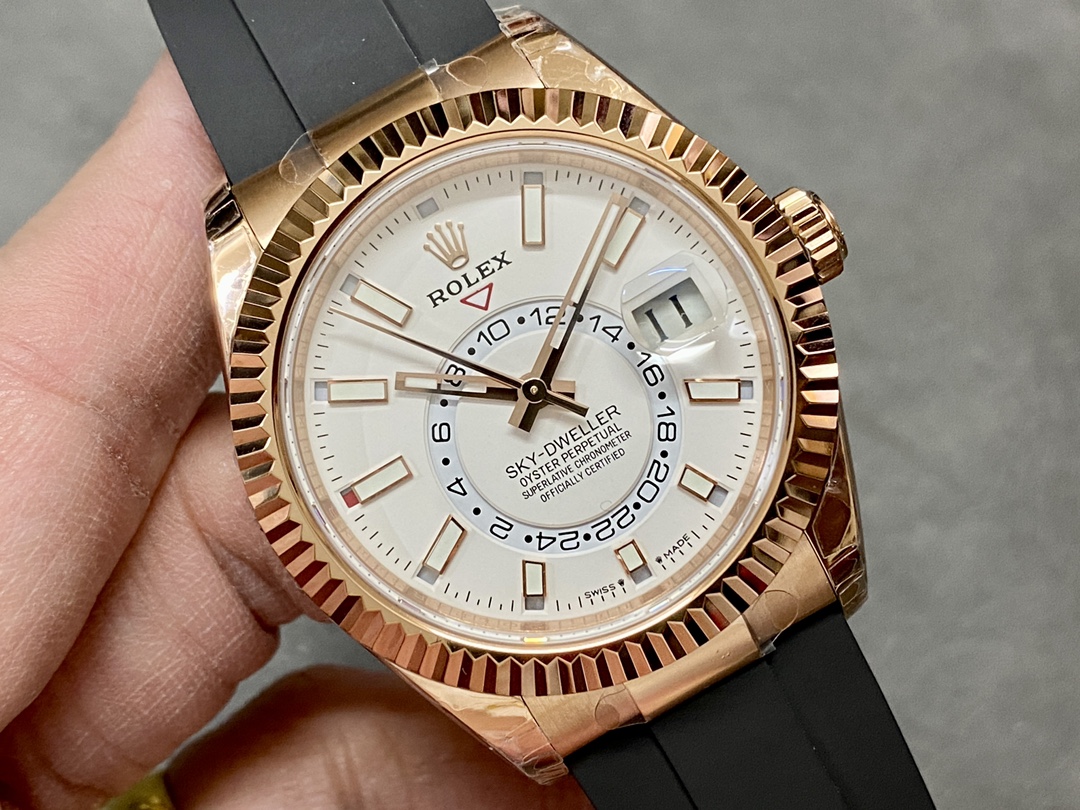
The 9002 is the movement Rolex introduced for the Sky-Dweller in 2023 as an evolution of the original 9001. It is an automatic calibre with 40 jewels, a 72-hour power reserve, and a frequency of 28,800 vibrations per hour (4 Hz). It measures 33 mm across and uses a ball-bearing rotor with bidirectional winding. What sets it apart from most Rolex movements is its complexity: the 9002 combines an annual calendar with a GMT function, an instantaneous date change, and a month indicator, all driven by what Rolex calls the “command selector” – a mechanism built around the crown that lets you cycle through which function you are setting.
The genuine 9002 features Rolex’s patented Chronergy escapement, a blue Parachrom hairspring, and Paraflex shock absorbers. The Chronergy escapement, in particular, is a nickel-phosphorus construction that improves energy efficiency and resistance to magnetic fields. In the real watch, these features combine to deliver accuracy certified to -2/+2 seconds per day after casing, which is extremely tight for a movement this complicated.
In the replica world, a 1:1 clone of the 9002 means the movement is reverse-engineered to match the genuine layout as closely as possible: same jewel count, same beat rate, same functional architecture. A true 1:1 clone will have the correct bridge shapes, the correct rotor design, and a similar winding feel. What it will not have – and this is critical – is the same metallurgy in the escapement and hairspring. The genuine Chronergy escapement uses materials and tolerances that Chinese manufacturers have not replicated. What they have done is build a functional movement that operates on the same principles with a layout that looks correct through a display back.
Here is the part most buyers get wrong. They assume that a cloned 9002 will behave like the genuine article in daily wear. It will not, and it was never going to. What it can do is deliver reliable timekeeping for years if you treat it properly. From what I have seen, a well-built 9002 clone runs within 5 to 10 seconds per day out of the box and settles into a stable rhythm after the first few weeks. The 72-hour power reserve is achievable in practice, though the last 10 to 12 hours will show noticeable rate deviation as the mainspring torque drops.
The practical takeaway: if you want a Sky-Dweller replica, the 9002 is the correct movement. Not because it is perfect, but because it is the only one that gets the functionality right. A Sky-Dweller with a generic movement and a faux annual calendar is not a replica – it is a costume.
9002 vs. 3135 vs. 3235 – Where Each Movement Actually Stands
Putting these three movements side by side is not about declaring a winner. They serve different watches and different buyers. But understanding the differences helps you decide what you are actually paying for.
The 3135 is the older benchmark. It powered Submariners and Datejusts from the late 1980s until the mid-2010s, and the best clone of it – the VS3135 – remains the standard against which other cloned movements are judged. It has 31 jewels, runs at 28,800 vph, and offers around 48 hours of power reserve. The 3135 clone is reliable, well-understood by watchmakers, and relatively easy to service. If you are buying a 40 mm Submariner or an older Datejust, this is the correct movement.
The 3235 replaced the 3135 in most modern Rolex sports models from around 2015 onward. It runs at the same frequency but pushes the power reserve to approximately 70 hours and uses a Chronergy escapement similar in concept to the 9002’s. In the replica market, the best clone of the 3235 comes from VS Factory, which uses the Dandong 3235 – a movement that is consistently rated for its stability and low return rate. Independent comparisons have shown that the VS3235 holds time within roughly +/- 4 seconds per day in real-world use, which is genuinely impressive for a clone.
The 9002 sits at the top of the complexity ladder. It has the same beat rate and a longer power reserve than the 3135, but the annual calendar and GMT modules add layers of mechanical interaction that simply do not exist in the other two movements. This complexity is both the appeal and the risk. The appeal is that you get the correct functionality for a Sky-Dweller. The risk is that more moving parts mean more potential failure points, and servicing a complicated clone movement is not something every local watchmaker will take on.
The movement you choose should follow from the watch you want, not the other way around. Buying a Submariner with a 3235 clone and then wishing it had a 3135 because “the 3135 is more proven” is backwards thinking. Match the movement to the reference. A Sky-Dweller needs a 9002. A modern Submariner needs a 3235. A vintage-style Datejust needs a 3135. Getting this wrong is one of the most common – and most expensive – mistakes in this market.
A Common Mistake: Chasing Movement Specs You Will Never Use
This is the mistake I see more than any other, and it costs buyers real money.
A significant number of people who buy replica Rolex watches spend weeks comparing movement specifications on paper. They read about jewel counts, beat rates, and power reserves, and they use those numbers to decide which watch to buy. The problem is that most of these specifications have almost no impact on the experience of wearing the watch.
Let me put this in concrete terms. The difference between a 48-hour and a 72-hour power reserve matters if you rotate through multiple watches and leave them sitting for days at a time. If you wear the same watch every day, both reserves are more than sufficient. The number of jewels matters to a watchmaker examining the movement, not to you when you are checking the time. And the beat rate – 28,800 vph versus 21,600 vph – affects the smoothness of the seconds hand sweep, but only if you are staring at it closely enough to notice the difference.
What actually matters in daily wear is something the spec sheets never mention: how the movement behaves after six months of ordinary use. Does it still keep time? Has the winding feel degraded? Is the date change still crisp? Those are the questions that determine whether you got value from your purchase, and they have almost nothing to do with the numbers on a product page.
From what I have seen, the buyers who are happiest with their purchases are the ones who chose a movement based on one criterion: does it match the reference I am buying? They did not agonise over whether the 3235 clone has a marginally higher jewel count than the 3135 clone. They picked the right movement for the right watch and then evaluated the actual watch in their hands.
One common mistake is treating the movement choice as the final decision when it is really the starting point. Once you have confirmed the movement is correct, the real evaluation begins: case finishing, dial printing, bracelet weight, and the feel of the crown when you screw it down. Those are the details that separate a watch you will enjoy wearing from one you will regret buying.
Factory Quality – Why the Factory Name on the Listing Is Not Enough
The relationship between the movement and the factory that builds the watch around it is where things get genuinely complicated. Two factories can use the same 3235 clone movement and produce watches of noticeably different quality, because the movement is only one part of the assembly.
In the current market, the factories that consistently produce high-quality Rolex replicas operate at different tiers. Clean Factory (CF) is widely regarded as the benchmark for Rolex sports models, particularly the Submariner and GMT-Master II. Their case work, bezel execution, and dial precision are consistently strong, and they use cloned VR-series movements alongside their own finishing standards. VS Factory (VSF) is known for its movement strength – specifically the Dandong 3235 and 3135 clones – and has a reputation for lower return rates than most competitors. Their Sky-Dweller and Yacht-Master replicas are particularly well-regarded, though their production volume is lower than Clean’s.
The mistake buyers make is assuming that a “VSF” or “CF” label on a listing guarantees a certain quality level. It does not. Factories release batches, and batch quality varies. A strong Clean Submariner from one batch can be better finished than a weak VSF from another. The factory name tells you what the watch should be, not what the specific watch you receive will actually be.
What this means practically is that you need a source that inspects individual watches, not one that ships whatever arrives from the factory floor. This is where the difference between a good dealer and a great one becomes obvious. A great dealer will reject a watch with a misaligned bezel insert or a poorly finished case, even if it came from a top factory. A good dealer will ship it and hope you do not notice.
For buyers in Australia, the shipping and return logistics make this even more important. Sending a watch back to China for a defect costs time and money, and the process is not always smooth. Getting it right the first time matters more here than it does for buyers in markets where returns are easier.
When I look at a listing for a replica Rolex watch, the first thing I check is not the factory name. It is whether the seller provides real photographs of the actual watch, not stock images. If they cannot or will not show me the watch I am buying, I move on. That single policy has saved me from more disappointments than any amount of research into movement specifications.
Wrist Test vs. Macro Test – A Different Way to Judge Replica Quality
Most reviews of replica watches are conducted with a macro lens. Photographers zoom in on dial text, bezel engravings, and crown logos at 10x magnification, and they declare a winner based on details that no human eye will ever see at arm’s length. This approach has its place, but it has created a distorted picture of what actually matters.
I want to propose a different framework: the wrist test. Take the watch off the macro bench and put it on your wrist for a week. Do not photograph it. Do not compare it side by side with another replica. Just wear it.
Here is what the wrist test reveals that the macro test cannot.
First, it tells you whether the watch feels right. Weight distribution, bracelet flexibility, and the way the case sits against your wrist are things you only notice through extended wear. A watch that scores perfectly under magnification can feel top-heavy or uncomfortable after a few hours, and no amount of dial precision will fix that.
Second, it exposes the movement’s real-world behaviour. A movement that keeps perfect time on a timing machine can still have a stiff winding feel, a crown that is difficult to engage, or a date change that is sluggish rather than instant. These are the things you notice when you are setting the watch in the morning and wearing it through a full day of work.
Third, it tests the finishing in the way that matters. Polished surfaces on a replica watch look sharp under studio lighting. On your wrist, they accumulate scratches. How the watch ages – whether the brushed surfaces hide wear well, whether the polished areas develop character or just look damaged – is part of the ownership experience, and it is invisible to a macro lens.
The macro test still has value for one specific purpose: authentication. If you are buying a used watch and need to verify whether it is genuine or a super clone, magnification is your best tool. The tells that distinguish a tier-3 super clone from a genuine Rolex are mechanical and structural, and you need to look closely to find them. But for buyers choosing between replicas, the wrist test is the more honest evaluation.
My advice: use the macro test to screen out obvious problems, but make your final decision based on how the watch feels on your wrist after a week. If you cannot wear it before buying – which is the reality for most online purchases – find a seller who offers a return window and use it. That window is the closest thing you will get to a wrist test before committing.
A Practical Buying Framework for Australian Buyers
Putting all of this together, here is the decision sequence I would follow if I were buying today. It is not the only correct approach, but it is the one that has worked for me and for the people I have advised.
Start with the reference, not the movement. Decide which watch you actually want – a Sky-Dweller, a Submariner, a Datejust – and let that determine which movement is correct. If you want a Sky-Dweller, you are looking for a 9002 clone. If you want a modern Submariner, you are looking for a 3235 clone. If you want a 40 mm Submariner or an older Datejust, you are looking for a 3135 clone. Do not choose a watch because it has a movement you have read good things about. Choose the watch, then verify the movement.
Then verify the factory’s track record for that specific reference. Clean Factory may be the benchmark for Submariners, but that does not mean their Datejust is equally strong. VS Factory’s Dandong movements are excellent, but their case finishing on some references is only mid-tier. Look for reference-specific feedback, not general factory reputation.
Next, evaluate the seller, not just the watch. This is where the difference between a smooth purchase and a frustrating one is decided. The seller’s willingness to provide real photos, their return policy, and their communication before the sale tell you more about the likely outcome than any specification. A seller who answers detailed questions with detailed answers is a seller who will handle problems. A seller who only sends stock images and generic reassurances is a risk.
Finally, set realistic expectations for what you are buying. A 9002 clone is not a genuine 9002. It will not have the same escapement materials, the same finishing quality, or the same long-term durability. What it can offer is correct functionality, reliable daily timekeeping, and a wearing experience that satisfies most buyers – provided you maintain it properly and do not expect it to perform like a Swiss movement.
One practical note on maintenance: a complicated clone movement like the 9002 benefits from servicing every two to three years. This is not a watch you buy and forget. The annual calendar and GMT modules have lubrication points that dry out over time, and ignoring them will lead to failure. Budget for this when you buy, or accept that the watch will eventually stop working.
For buyers who want to explore options further, www.replicawatches.me offers a range of references with detailed movement information that I have found useful when comparing specifications. And for the actual purchase, replicafactory.cx has been a reliable source in my experience – they inspect individual watches before shipping and provide real photographs of the specific unit you are buying, which is the single most important thing a seller can do.
FAQ
Is the 9002 clone really 1:1, or is it a modified movement?
A true 1:1 clone of the 9002 matches the genuine layout: same bridge shapes, same jewel count, same functional architecture. But “1:1” in this context refers to visual and structural similarity, not material equivalence. The clone uses different metals in the escapement and hairspring. It is functionally correct, not metallurgically identical.
How accurate is a 9002 clone in daily use?
From what I have seen, a well-built 9002 clone runs within 5 to 10 seconds per day out of the box. After a few weeks of settling, most examples hold within 8 seconds per day. That is not chronometer-grade, but it is more than adequate for daily wear. If you need tighter accuracy, any watchmaker can regulate it.
Can I buy a Sky-Dweller replica without a 9002 clone?
You can, but you should not. A Sky-Dweller with a generic movement and a faux annual calendar is a fundamentally different watch. The 9002 clone is the only movement that delivers the correct functionality. If the seller cannot confirm the movement is a 9002 clone, walk away.
What is the realistic lifespan of a clone movement?
With proper maintenance – servicing every two to three years – a good clone movement can last five to seven years or longer. Without servicing, expect three to four years before performance degrades noticeably. The 9002, with its added complexity, is less forgiving of neglect than a simpler 3135 clone.
Why do two listings for the same watch cost $200 apart?
The difference is almost always in the finishing details and the specific batch. A $700 Clean Factory Submariner and a $500 version from a lesser factory may use the same movement, but the case finishing, bracelet quality, and dial printing will differ. The cheaper version is not a scam – it is a lower tier of the same product category.
Is it worth paying extra for a VS Factory movement over a VR movement?
In my experience, yes, if you plan to keep the watch long-term. The VS Dandong movements have a lower return rate and better long-term stability. The VR movements are competent, but they are a tier below. For a daily wearer, the extra cost is justified.
How do I verify the movement is what the seller claims?
Ask for a photograph of the movement through the case back, or if the watch has a solid case back, ask the seller to confirm the movement model in writing. A reputable seller will not hesitate. If they deflect or provide vague answers, treat that as a red flag.
Do I need to declare a replica watch when shipping to Australia?
This is a legal question, not a mechanical one, and the answer depends on your circumstances. Counterfeit goods are subject to border controls in Australia. I cannot advise you on how to navigate this, but I can tell you that shipping method and seller experience matter significantly. Choose a seller who has a track record of delivering to Australian addresses.